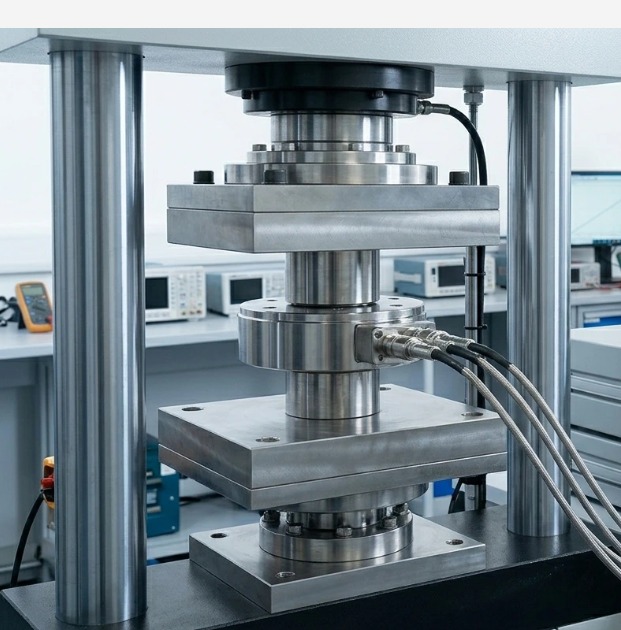
Every force measurement your organization relies on — for quality control, structural testing, production monitoring, or regulatory compliance — is only as trustworthy as the last calibration of the load cell behind it. At SR UNIQ Measurement Technologies & Consultancy, we deliver load cell calibration with the precision, traceability, and technical documentation that engineers and quality systems demand.
Operating from our purpose-built force calibration laboratory in GB Nagar, Uttar Pradesh, SR UNIQ calibrates load cells from 50 N to 3000 kN using dead weight force machines — the most accurate force standard available — in full compliance with ISO 376:2011, ASTM E74, EURAMET CG-4, and NABL 129.
Service Parameter | SR UNIQ Specification |
Calibration Range | 50 N to 3000 kN (Continuous) |
Force Standard Used | Dead Weight Force Machine |
Applicable Standards | ISO 376:2011 | ASTM E74 | EURAMET CG-4 | NABL 129 |
Accuracy Classes | Class 00 | Class 0 | Class 1 | Class 2 |
Temperature Control | 23°C ± 2°C (ISO 376 compliant) |
Turnaround Time | 24 to 48 Hours (Standard) |
On-Site Calibration | Available |
Certificate Type | Traceable to NPL India / NABL |
A load cell is a force transducer — a precision electromechanical device that converts an applied mechanical force into a proportional electrical signal. Inside every load cell, bonded strain gauges on a machined elastic element form a Wheatstone bridge circuit. When force deforms the elastic element, resistance changes translate into a measurable output voltage.
Load cell calibration is the formal, documented process of comparing this electrical output against known, traceable reference forces — and determining how accurately the load cell represents the forces applied to it across its full measurement range.
The calibration process quantifies the following performance parameters:
The result of calibration is a calibration certificate — a technically and legally significant document that records all measurement results, expanded uncertainty, traceability chain, and the accuracy classification of the instrument.
Load cells are precision instruments, but their precision is not permanent. Multiple mechanisms cause output to shift from the factory specification over time:
Each loading cycle stresses the bonded strain gauges and their adhesive interface. Over millions of cycles, adhesive creep causes the gauge-to-element coupling to soften, altering the sensitivity. This process is gradual, invisible, and detectable only through calibration against a traceable reference.
The steel or aluminium body of a load cell undergoes progressive stress relaxation under repeated loading. This causes a slow but measurable shift in the element’s elastic modulus, changing the relationship between applied force and output voltage. Instruments calibrated five years ago and used continuously since then should be treated as unverified.
Temperature cycling, humidity ingress, chemical exposure, and mechanical vibration all contribute to gradual drift. Load cells used on production floors, outdoor sites, or near machinery experience accelerated degradation compared to those in controlled laboratory environments.
A single overload — applying force beyond the rated capacity — can permanently deform the elastic element and shift the calibration curve. This is particularly dangerous because the load cell may continue to function and display readings that appear normal, while the actual output is systematically incorrect. Calibration after any suspected overload is mandatory before the instrument is returned to service.
ISO 9001:2015 Clause 7.1.5, IATF 16949, AS9100, and IS/ISO 17025 all require that force-measuring instruments used in quality, testing, and verification activities be calibrated at defined intervals with documented traceability to national or international standards. A load cell with an expired calibration certificate is a documented non-conformance in any formal quality audit.
SR UNIQ calibrates load cells in compliance with the following internationally recognized standards:
The primary international standard for force calibration. ISO 376:2011 defines four accuracy classes (00, 0, 1, 2), the minimum number of measurement series required for each class, the loading sequence, and the mathematical criteria for class assignment. This is the standard referenced in most quality management system requirements for load cell calibration.
The American standard for force calibration using dead weight machines. ASTM E74 introduces the Lower Limit Factor (LLF) concept, which defines the minimum reliable force that can be measured by the instrument based on its calibration performance. Essential for instruments used in US-connected supply chains including aerospace, automotive, and defense sectors.
The European calibration guideline that governs the evaluation and reporting of measurement uncertainty in force calibration. SR UNIQ constructs full uncertainty budgets per EURAMET CG-4, covering dead weight machine uncertainty, thermal effects, transducer repeatability, hysteresis, and resolution — reported as expanded uncertainty at 95% confidence (k=2).
The NABL document defining competence requirements for accredited force calibration laboratories in India. Calibration certificates traceable to NABL-accredited facilities are accepted by ISO auditors, government regulatory bodies, and customers under Legal Metrology requirements across Indian industry. SR UNIQ operates in full alignment with NABL 129, with reference standards traceable to the National Physical Laboratory of India (NPL).
Every load cell calibration at SR UNIQ follows a rigorous, documented procedure that meets the requirements of ISO 376:2011 and NABL 129:
SR UNIQ calibrates all commercially significant load cell types across the full range of 50 N to 3000 kN:
Load Cell Type | Typical Applications |
Compression load cell | Platform scales, press force monitoring, structural load testing, compression testing machines |
Tension load cell | Crane scales, cable tension testing, material pull testing, hanging weight applications |
Universal (T+C) load cell | Universal testing machines (UTMs), Instron frames, fatigue testing rigs |
S-beam load cell | Automation systems, conveyor tension, industrial scales, test rigs |
Shear beam load cell | Tank weighing, floor scales, silo load monitoring, belt weighers |
Pancake / disc load cell | Bolt load monitoring, press fitting, structural bearing load measurement |
Proving ring load cell | Soil and geotechnical testing, concrete strength testing, legacy calibration references |
In-line load cell | Production line force monitoring, assembly verification, dynamic force measurement |
We also calibrate load cells from brands including Morehouse, Interface, Omega, FUTEK, Instron, Mettler Toledo, Precia Molen, and ADS-R instrumentation systems. If your load cell was manufactured by any recognized brand or is a custom/OEM type, contact us to confirm calibration capability.
SR UNIQ’s load cell calibration services support quality and measurement confidence across a broad range of industries:
Industry | Load Cell Application |
Aerospace & Defense | Structural testing, thrust measurement, component load verification |
Automotive & IATF 16949 | Crash testing, press force monitoring, assembly QC |
Pharmaceuticals & Medical | Tablet press force, packaging seal testing, biomechanics |
Civil & Structural Engineering | Pile load testing, anchor pull-out, bearing load monitoring |
Material Testing (UTMs) | Tensile, compression, fatigue, and flexure testing |
Food & Beverage Processing | Filling weight verification, packaging force QC |
Energy & Power Generation | Turbine component load, wind tower structural monitoring |
Academic & R&D Laboratories | Experimental force measurement, calibration traceability |
Weighing and Legal Metrology | Weighbridge verification, trade weight measurement |
If you are working with an HX711 load cell amplifier — whether in an Arduino-based weighing system, a custom IoT device, or a research prototype — calibration of the load cell connected to the HX711 is just as important as calibrating any industrial instrument.
The HX711 is a 24-bit ADC designed specifically for load cell signal conditioning. Calibrating the complete system — the load cell, HX711 amplifier, and microcontroller code — involves applying known reference weights and deriving scale factors to convert raw ADC counts into accurate force or weight readings.
SR UNIQ calibrates the load cell element itself — the primary sensing device — against our dead weight force machine reference. This provides you with:
Whether your application is an Arduino prototype, a custom industrial scale, or a research instrument built around the HX711, calibrating the load cell at the source gives your entire measurement chain a credible metrological foundation.
A load cell system has two critical components: the load cell itself and the indicator (signal conditioner or amplifier) that reads and displays its output. Calibrating only one component leaves the system’s overall accuracy unverified.
SR UNIQ calibrates both load cell indicators and complete load cell systems (transducer plus indicator, calibrated as an integrated unit). Indicator calibration verifies:
For customers using load cell indicators from brands such as ADS-R amplifiers, Mettler Toledo indicators, Precia Molen systems, or custom signal conditioners, system-level calibration at SR UNIQ ensures the complete measurement chain is verified and certified.
Shunt calibration is a quick electrical verification method used in the field to check whether a load cell and its associated instrumentation are functioning correctly, without applying actual mechanical force. It works by connecting a precision resistor (the shunt) across one arm of the Wheatstone bridge, simulating a specific known electrical output equivalent to a defined applied force.
Shunt calibration is useful for:
However, shunt calibration is not a substitute for mechanical calibration against a traceable force standard. It verifies electrical integrity, not force measurement accuracy. The shunt resistor value used must be specific to the load cell model, and the simulated force equivalent must be established during a full mechanical calibration.
SR UNIQ performs full mechanical calibration that establishes the reference baseline from which shunt calibration values are derived. We can also advise on shunt calibration setup for your specific load cell model and indicator combination.
Setting calibration intervals requires balancing measurement risk against operational cost. Use these guidelines to establish technically justified intervals for your load cells:
Application Type | Recommended Calibration Interval |
Reference standard load cells | Every 6 months |
Production QC and testing (daily use) | Annually (ISO 9001 / IATF minimum) |
Safety-critical applications | Every 6 months or before each critical test |
Post-overload or post-impact event | Immediately — before return to service |
Harsh environment (outdoor / high humidity) | Every 6 months |
After connector replacement or repair | Immediately — before return to service |
A: Calibration is a comprehensive technical process that measures the load cell’s actual output at multiple points across its range, determines the error at each point, and produces a calibration certificate with documented uncertainty. Verification only checks whether the instrument passes or fails a simple tolerance test — it does not produce measurement data or uncertainty values. Most ISO and NABL quality management systems require full calibration, not just verification, for instruments used in quality-critical measurements.
A: Several signs indicate that unscheduled calibration may be necessary: the load cell was subjected to an overload or impact event; the zero reading has shifted significantly from its previous baseline; readings are inconsistent between cycles on the same applied force; the connector or cable was replaced or repaired; the instrument was dropped or mechanically shocked; or the operating environment has changed substantially (temperature, humidity, chemical exposure). If any of these conditions apply, do not wait for the scheduled due date — contact SR UNIQ for an immediate assessment.
A: Yes. SR UNIQ’s calibration capability is brand-agnostic. We calibrate load cells from all major manufacturers including Morehouse, Interface, FUTEK, Instron, Mettler Toledo, Omega, Precia Molen, HBM, Kistler, and all other commercially available load cell brands. The calibration is performed against our dead weight force machine reference standard — the instrument’s brand or origin does not affect the accuracy or traceability of our calibration results.
A: ISO 376:2011 classifies force-proving instruments into four accuracy classes based on their calibration performance: Class 00 (highest accuracy, used as primary reference standards), Class 0 (used as reference or transfer standards), Class 1 (used in precision testing and quality control applications), and Class 2 (used in general industrial measurement). The class appropriate for your application depends on your measurement uncertainty requirements. For most production QC, material testing, and audit-compliance applications, Class 1 is the standard requirement. SR UNIQ can advise on the correct class for your specific application and instrument capability.
A: The HX711 is a 24-bit ADC used to amplify and digitize the low-voltage output of a load cell. When you build a weighing or force measurement system with an HX711 and Arduino or similar microcontroller, the accuracy of the entire system depends on the accuracy of the load cell and the conversion factors programmed into the software. SR UNIQ calibrates the load cell element against our dead weight force machine and provides verified sensitivity values (mV/V at specific force points) that you can use to calculate accurate conversion factors for your HX711 code. This gives your custom measurement system a fully traceable metrological foundation.
A: Shunt calibration is an electrical verification technique that applies a precision resistor across one arm of the load cell’s Wheatstone bridge to simulate a specific output equivalent to a known force. It is useful for checking that the load cell wiring and indicator are functioning correctly without applying mechanical force — particularly after installation or cable work. However, shunt calibration does not apply actual force to the load cell and therefore cannot verify the mechanical accuracy of the sensing element. It is a supplementary check, not a substitute for full traceable mechanical calibration against a dead weight force machine.
A: Every SR UNIQ calibration certificate contains: unique certificate reference number; complete instrument identification (make, model, serial number, rated capacity, sensitivity); calibration date and next due date; applied reference force values at each calibration point; measured load cell output at each point; percentage error (deviation) at each point; expanded measurement uncertainty with coverage factor k=2 (95% confidence); environmental conditions during calibration (temperature, humidity); applicable calibration standards (ISO 376:2011, ASTM E74); traceability statement to NPL India / NABL; and the responsible calibration engineer’s identification and sign-off.
A: Yes. For load cells that are permanently integrated into test machines, press systems, structural monitoring setups, weighbridges, or other installations where removal is impractical or risky, SR UNIQ provides on-site calibration services. Our portable calibration equipment maintains the accuracy and traceability standards of our laboratory service. Contact us at 8750841107 or info@sruniq.com to discuss the technical requirements and logistics for your specific installation.
A: Calibration of a compression machine load cell — such as those installed in concrete compression testers, hydraulic press machines, or universal testing machines — follows ISO 376:2011 procedures. The load cell is removed from the machine (or calibrated in situ if on-site calibration is requested), mounted on our dead weight force machine, thermally stabilized, preloaded, and then measured at multiple defined force points in ascending and descending sequences. The resulting calibration certificate documents the load cell’s accuracy and uncertainty at each measurement point, covering the full working range of the compression machine. SR UNIQ can also advise on the acceptable calibration interval for compression machine load cells based on their usage frequency and ISO compliance requirements.
A: Contact SR UNIQ at info@sruniq.com or call 8750841107 to initiate a calibration request. Please share the load cell’s make, model, rated capacity, sensitivity specification, and excitation voltage. We will confirm our capability and issue a quote. You can ship or hand-deliver your load cell to our facility at Khasra No. 179, Vashrabad Village, Dadri, GB Nagar, Uttar Pradesh — 203207. Standard laboratory turnaround is 24 to 48 hours from the time of instrument receipt. For urgent requirements, please mention this when making contact and we will advise on availability.