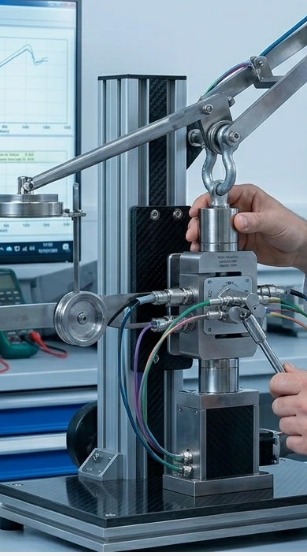
Introduction: The Science of Accurate Force Sensing A Force Transducer is the critical component that converts mechanical force into a measurable electrical signal. Whether it is a strain-gauge-based load cell or a sophisticated piezoelectric sensor, its reliability defines the safety and quality of your entire operation. At SR UNIQ Measurements Technologies and Consultancy P Ltd, we provide world-class Force Transducers Calibration Services that ensure every millivolt of output translates to an accurate unit of force.
Specialized Calibration for All Transducer Types Our facility in Dadri, GB Nagar, UP is engineered to handle various geometries and capacities of force sensors:
S-Beam & Tension Links: Ensuring accuracy for crane scales and suspension testing.
Button & Pancake Load Cells: Precision testing for space-constrained industrial applications.
Compression Force Transducers: Validating high-capacity hydraulic presses and structural testing rigs.
Multi-Axis Sensors: Calibrating complex sensors that measure force in X, Y, and Z planes.
Our High-Standard Calibration Procedure We don’t just check numbers; we validate physics. Our force transducer calibration procedure includes:
Excitation Voltage Stabilization: Checking the input power stability to ensure consistent signal output.
Shunt Calibration & Linearity: Verifying the electrical gain and ensuring the sensor responds linearly across its full range.
Creep & Hysteresis Testing: Analyzing if the transducer returns to zero accurately after sustained loading.
Signal Conditioning Sync: We calibrate the transducer along with its digital indicator as a complete system for maximum accuracy.
Industries We Serve: Powering Global Standards SR UNIQ is a trusted partner for sectors where force measurement is a “Zero Error” requirement:
Aerospace: Critical force measurements for aircraft testing, structural fatigue, and engine thrust analysis.
Automotive: Component testing and quality assurance, including crash test dummy sensors and brake force analysis.
Manufacturing: Production line calibration for automated assembly and torque-to-force conversion.
Defense: Maintaining military equipment testing standards for ballistics and impact resistance.
Medical: Healthcare equipment precision for robotic surgery arms and rehabilitation force sensors.
Construction: Material testing equipment calibration for bridge bearings and soil pressure cells.
Energy: Power generation monitoring for turbine blade tension and structural integrity.
Research: Academic and R&D laboratories requiring high-resolution data for material science.
The SR UNIQ Advantage in Ghaziabad Based at Dadri, GB Nagar, UP, 203207, we understand that force transducers are often integrated into large machines. We offer both laboratory-grade precision and on-site expertise to minimize your production downtime. Our engineers provide a detailed uncertainty analysis with every certificate, giving you the technical confidence to pass any quality audit.
1. What is the difference between a load cell and a force transducer? Technically, they are the same. A force transducer is a broader term for any device that converts force into an electrical signal, while “load cell” is the term commonly used in industrial weighing.
2. Why does my force transducer need regular calibration? Environmental factors, electrical surges, and mechanical overloads can shift the “Zero” and “Span” of the sensor, leading to measurement errors.
3. Can you calibrate transducers from brands like HBM, Flintec, or Zemic? Yes, we provide calibration services for all major global and local brands of force transducers and load cells.
4. What is “Shunt Calibration”? Shunt calibration is a method used to simulate a load on a strain-gauge transducer to check the electrical integrity of the circuit and indicator.
5. How often should I calibrate force transducers used in construction? Due to harsh environments and high-impact loads, we recommend a 6-month calibration cycle for construction and material testing equipment.
6. Do you provide a “System Calibration” (Sensor + Indicator)? Yes. We highly recommend calibrating the transducer and the digital indicator together as a matched pair to eliminate signal processing errors.
7. Is your laboratory NABL traceable for force measurement? Yes, all our force measurement services are traceable to National Standards (NPL), ensuring your data is legally and technically valid.
8. What happens if a transducer has a high “Non-Linearity” error? Our engineers will analyze the data. If the error is consistent, we can often adjust the digital indicator to compensate for the transducer’s non-linearity.
9. Can you calibrate multi-axis force sensors? Yes, we have specialized setups to handle transducers that measure forces in multiple directions simultaneously.
10. How do I get a quote for my force transducer calibration? Contact our Dadri, GB Nagar, UPoffice at 087508 41107 with your transducer’s capacity and model details for a customized quote.