


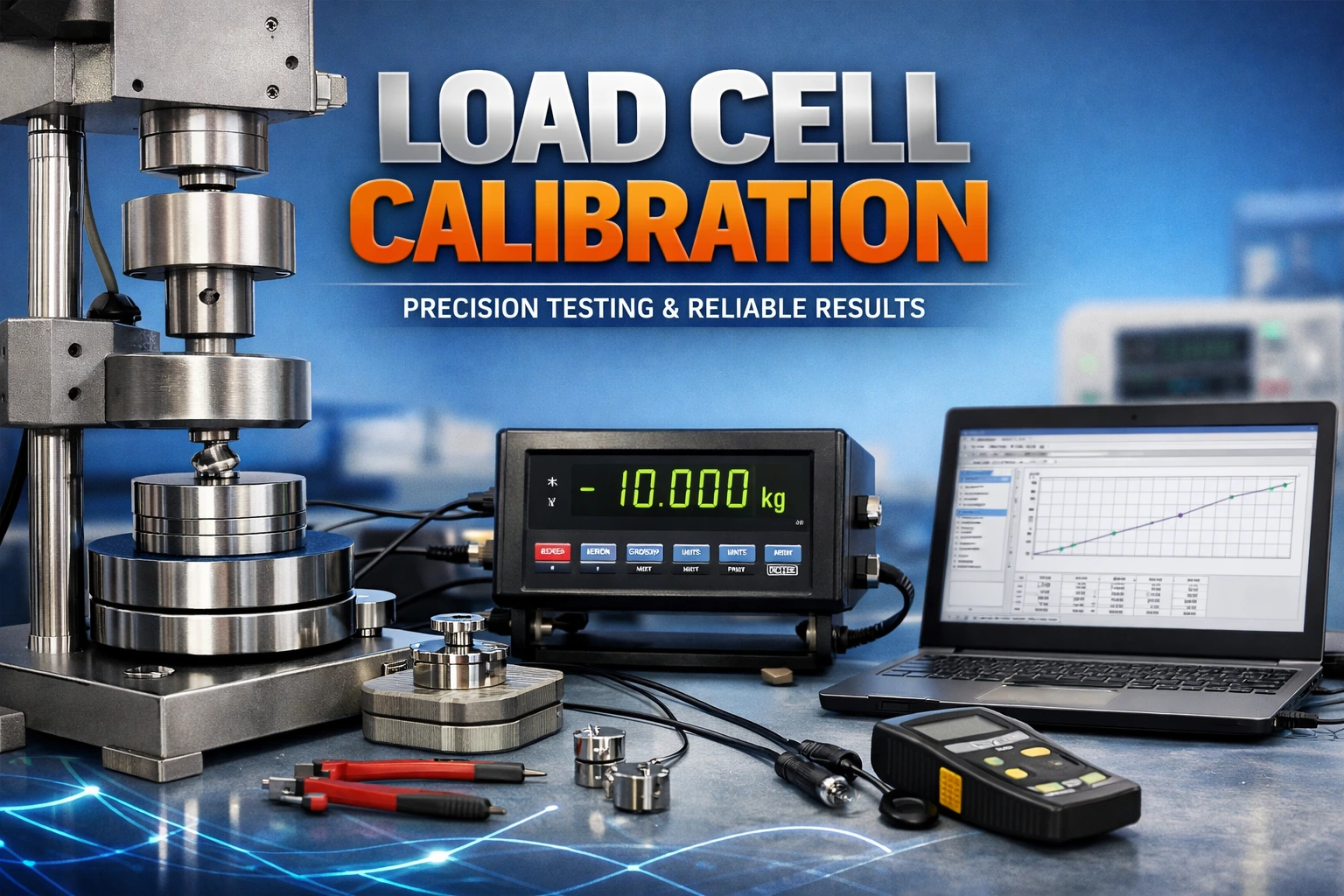
11 Apr Load Cell Calibration: Everything You Need to Know About Getting It Right
Whether you run a manufacturing plant, a testing laboratory, or a quality control department — if you use load cells in your operations, there is one question you cannot afford to ignore: Is your load cell giving you accurate readings?
A load cell that reads even 0.5% off its true value can lead to rejected batches, failed structural tests, incorrect billing, and in critical sectors like aerospace or defense, results that risk lives. The solution is straightforward but non-negotiable: regular, professional load cell calibration.
In this blog, we at SRUNIQ — one of India’s most advanced force calibration laboratories — will walk you through everything you need to understand about load cell calibration: what it is, why it matters, how it is done, what standards govern it, and how to find the right load cell calibration service near you.
What Is a Load Cell?
Before diving into calibration, let us quickly understand the instrument itself. A load cell is a transducer — a device that converts a mechanical force (like compression, tension, or shear) into an electrical signal. That electrical signal is then read by a display or data acquisition system to show you the magnitude of the force applied.
Load cells are found everywhere in modern industry:
- Weighbridges and industrial weighing scales
- Material testing machines in R&D labs
- Force measurement in automotive crash testing
- Structural load monitoring in civil engineering
- Quality control on production lines
- Tension measurement in wire, cable, and textile manufacturing
- Aerospace component stress analysis
Their ubiquity makes their accuracy critical. A faulty load cell reading is not just an inconvenience — it can be a safety hazard and a compliance violation.
What Is Load Cell Calibration?
Load cell calibration is the process of comparing the output of a load cell against a known, traceable reference standard — and then establishing a correction factor or confirming the instrument is performing within its specified accuracy limits.
In simple terms: you apply a precise, known force to the load cell and check whether it reports that force correctly. If there is a deviation, the calibration process quantifies it and a calibration certificate documents the results.
Calibration does not always mean “adjustment.” It means measurement and verification. The output of calibration is a calibration certificate that shows:
- The applied reference force values
- The load cell’s actual output at each point
- The deviation or error at each measurement point
- Measurement uncertainty
- A statement of traceability to national or international standards
Why Is Load Cell Calibration So Important?
Many engineers assume that a load cell that was accurate when purchased will stay accurate forever. That is a dangerous assumption. Load cells drift over time for several reasons:
1. Mechanical Wear and Fatigue
Every time a load cell is used, it undergoes microscopic deformation. Over millions of cycles, this leads to fatigue in the sensing element (usually a strain gauge bonded to a metal body), causing the output to shift from its original specification.
2. Environmental Exposure
Temperature changes, humidity, dust, vibration, and chemical exposure all affect the internal components of a load cell. A load cell used in an outdoor environment or near heavy machinery will experience drift much faster than one kept in a controlled lab.
3. Overloading Events
Even a single accidental overload — applying force beyond the rated capacity — can permanently alter a load cell’s characteristics. After such an event, calibration is essential to determine whether the instrument is still within acceptable accuracy limits.
4. Regulatory and Quality Compliance
ISO 9001, NABL accreditation requirements, IATF 16949 for automotive, AS9100 for aerospace, and numerous other quality management frameworks mandate that all measuring instruments, including load cells, be calibrated at defined intervals with documented traceability.
5. Commercial and Legal Requirements
In trade applications — such as weighbridges used for billing freight — accurate force and weight measurement is a legal requirement under the Legal Metrology Act. An uncalibrated or out-of-tolerance load cell can expose a business to legal liability.
Understanding Calibration Standards for Load Cells
Professional load cell calibration is not a casual process. It is governed by internationally recognized standards that define procedures, uncertainty requirements, environmental conditions, and documentation.
The most important standards are:
ISO 376:2011
This is the primary international standard for the calibration of force-proving instruments, including load cells used as reference standards. It defines four accuracy classes (Class 00, 0, 1, and 2) based on allowable errors and repeatability. SRUNIQ operates under ISO 376:2011 to ensure globally accepted calibration results.
ASTM E74
The American Society for Testing and Materials standard ASTM E74 governs the calibration of force-measuring instruments using dead weight machines. It is widely referenced in aerospace, defense, and advanced manufacturing sectors, especially for customers with US-based supply chain requirements.
EURAMET CG-4
This is a calibration guideline from the European Association of National Metrology Institutes. EURAMET CG-4 provides detailed guidance on uncertainty evaluation for force calibration — a critical part of any professional calibration output.
NABL 129
For customers operating in India, NABL (National Accreditation Board for Testing and Calibration Laboratories) accreditation is the gold standard. NABL 129 defines the technical requirements for force calibration laboratories in India. A calibration certificate issued by a NABL-accredited lab carries legal and regulatory weight and is accepted by most quality auditors and regulatory bodies across Indian industries.
At SRUNIQ, our calibration services are conducted in compliance with all four of these standards, ensuring that our certificates are accepted by auditors, customers, and regulatory bodies both in India and internationally.
How Load Cell Calibration Is Actually Performed
Understanding the process helps you ask the right questions when selecting a calibration service. Here is a step-by-step overview of how professional load cell calibration works:
Step 1: Visual and Physical Inspection
Before any measurement begins, the load cell is inspected for physical damage, corrosion, connector integrity, cable condition, and signs of overloading. Any anomalies are documented.
Step 2: Environmental Conditioning
The load cell is placed in a climate-controlled calibration environment to stabilize at the required temperature (typically 23°C ± 2°C as per ISO 376). Rushing this step introduces thermal errors.
Step 3: Connection and Zero Check
The load cell is connected to its indicator or signal conditioner. A zero reading is taken and noted. Any zero offset outside acceptable limits is flagged.
Step 4: Loading Sequence on Dead Weight Machine
The load cell is placed on a dead weight force machine — the most accurate type of force standard available. Dead weight machines apply force using precisely calibrated masses under controlled gravity conditions, eliminating the uncertainty associated with reference load cells or hydraulic systems.
At SRUNIQ, our dead weight force machines cover 50 N to 3000 kN — one of the widest force calibration ranges in India — allowing us to calibrate everything from small lab-grade sensors to heavy-duty industrial load cells without switching facilities or degrading accuracy.
Step 5: Multi-Point Measurement and Repeatability Testing
Forces are applied at multiple points across the load cell’s range — typically in both increasing and decreasing sequences, and in multiple orientations if applicable (for tension-compression types). This is done three or more times to evaluate repeatability.
Step 6: Uncertainty Analysis
The calibration engineer calculates the measurement uncertainty, which accounts for the uncertainty of the reference standard, environmental variations, repeatability of the device under test, and digital resolution. This is reported in the calibration certificate as an expanded uncertainty at a 95% confidence level.
Step 7: Calibration Certificate Issuance
A detailed calibration certificate is generated documenting all applied forces, measured outputs, deviations, uncertainty, environmental conditions during calibration, traceability chain, and the calibration engineer’s details. The certificate carries a unique identification number and the validity period.
Types of Load Cells SRUNIQ Calibrates
At SRUNIQ Measurement Technologies & Consultancy, we calibrate a comprehensive range of load cell types across all industry sectors:
- Compression load cells — used in platform scales, press testing, and structural testing
- Tension load cells — used in crane scales, cable tension measurement, and material pull testing
- Universal (compression + tension) load cells — used in universal testing machines (UTMs)
- S-type load cells — common in hanging scales and tension-compression applications
- Pancake / disc load cells — used in bolt load monitoring and precision force measurement
- In-line load cells — used in dynamic force measurement in production lines
- Shear beam load cells — used in floor scales and tank weighing
Capacity range: 50 N to 3000 kN. If you are unsure whether your load cell falls within our range, contact us — in most cases, it does.
How Often Should You Calibrate Your Load Cells?
The calibration interval depends on several factors specific to your application:
- Usage frequency — Load cells used daily need more frequent calibration than those used monthly
- Industry standard requirements — Automotive (IATF 16949), aerospace (AS9100), and NABL-accredited labs typically require annual calibration at minimum
- Environmental severity — Harsh environments accelerate drift; calibrate more often
- Post-overload events — Always recalibrate after an overloading incident, even if the cell appears undamaged
- After repair or refurbishment — Any mechanical intervention requires recalibration
As a general industry guideline, most load cells used in production or quality control environments are calibrated annually. Critical reference-grade load cells in metrology labs may be calibrated every six months. SRUNIQ provides recommendations specific to your load cell model and application.
What to Look for in a Load Cell Calibration Service Near You
If you are searching for load cell calibration services near you, do not settle for the first name that appears in a directory. Here are the key factors to evaluate:
1. NABL Accreditation or Traceability to NABL
In India, a calibration certificate is only as good as its traceability. Ensure the laboratory is NABL-accredited for force calibration or that its reference standards are traceable to NABL or NPL (National Physical Laboratory, India).
2. Dead Weight Force Machine
The highest accuracy in force calibration comes from dead weight machines — not from comparisons against hydraulic force standards or reference load cells alone. Ask whether the lab uses a dead weight machine, and for what force range.
3. Range Coverage
Many calibration labs have limited force ranges — they may cover only up to 50 kN or 100 kN. If your load cell is rated at 500 kN or 1000 kN, you need a lab that can actually apply those forces. SRUNIQ covers 50 N to 3000 kN, which handles virtually all industrial and commercial load cells.
4. Certified and Experienced Calibration Engineers
Calibration is not a machine-only process. Experienced engineers understand load cell behavior, recognize anomalous readings, and provide meaningful uncertainty analysis. Ask about the qualifications of the team.
5. Turnaround Time
If your load cells are critical instruments, downtime matters. SRUNIQ offers a standard turnaround time of 24 to 48 hours for most calibrations, minimizing disruption to your operations.
6. Comprehensive Documentation
A professional calibration certificate should include measurement data, uncertainty values, environmental conditions, and traceability statement — not just a pass/fail stamp. Review a sample certificate before committing to a service provider.
Why Industries Across India Trust SRUNIQ for Load Cell Calibration
SRUNIQ Measurement Technologies & Consultancy, based in GB Nagar (Greater Noida / Ghaziabad area), Uttar Pradesh, has established itself as a leading force calibration laboratory in North India. Here is why engineers and quality managers choose us:
- Widest calibration range in India: 50 N to 3000 kN on dead weight force machines
- Compliance with ISO 376:2011, ASTM E74, EURAMET CG-4, and NABL 129
- Climate-controlled calibration environment for temperature-stable measurements
- Full uncertainty analysis included with every calibration certificate
- Experienced team of calibration engineers and metrologists
- 24 to 48 hours standard turnaround time
- Service to aerospace, automotive, manufacturing, construction, defense, energy, research, and medical sectors
- Over 10,000 instruments calibrated annually
- On-site calibration support available for large or immovable equipment
We understand that downtime is expensive and compliance is non-negotiable. Our processes are designed to deliver fast, accurate, and fully documented calibration that your quality auditors will accept without question.
Frequently Asked Questions About Load Cell Calibration
Can I use my load cell after its calibration due date?
Technically, yes — but you are operating on assumption rather than verified data. More importantly, if a non-conformance is discovered and your load cell was past its calibration due date, your quality system will flag every measurement made after the expiry. This can lead to costly product recalls or re-testing. Stay ahead of your calibration schedule.
What is the difference between calibration and verification?
Calibration establishes the relationship between the instrument’s output and the true value, including uncertainty. Verification only checks whether the instrument passes or fails a predefined tolerance. For most quality management systems, calibration is required.
Do you offer on-site load cell calibration?
Yes. For load cells that are integrated into large structures, testing machines, or weighbridges where removal is impractical, SRUNIQ offers on-site calibration services. Contact us to discuss your specific setup.
How do I send my load cell to SRUNIQ?
Simply contact us at info@sruniq.com or call 8750841107. We will guide you through the submission process, packaging requirements, and documentation needed. Our facility is located at Khasra No. 179, Vashrabad Village, Dadri, GB Nagar, UP — 203207.
What does a calibration certificate from SRUNIQ include?
Our certificates include: instrument identification details, calibration date and due date, applied force values, measured output, deviation at each point, expanded measurement uncertainty, environmental conditions during calibration, traceability statement, and the responsible calibration engineer’s details.
Don’t Let Inaccurate Load Cells Cost You More Than a Calibration
Load cell calibration is not a bureaucratic formality — it is a fundamental requirement of sound engineering practice and quality management. Whether you need to comply with an ISO audit, satisfy a customer’s PPAP requirement, or simply ensure your production data is reliable, calibration is the starting point.
The cost of calibration is small. The cost of acting on inaccurate force data — through product failures, rework, failed audits, or safety incidents — is enormous.
At SRUNIQ, we have built our entire capability around giving engineers and quality teams the certainty they need. With one of the widest force calibration ranges in India, internationally recognized standards compliance, and a fast turnaround time, we are the partner you want when accuracy is not optional.
Ready to schedule your load cell calibration? Get in touch with the SRUNIQ team today.
No Comments