


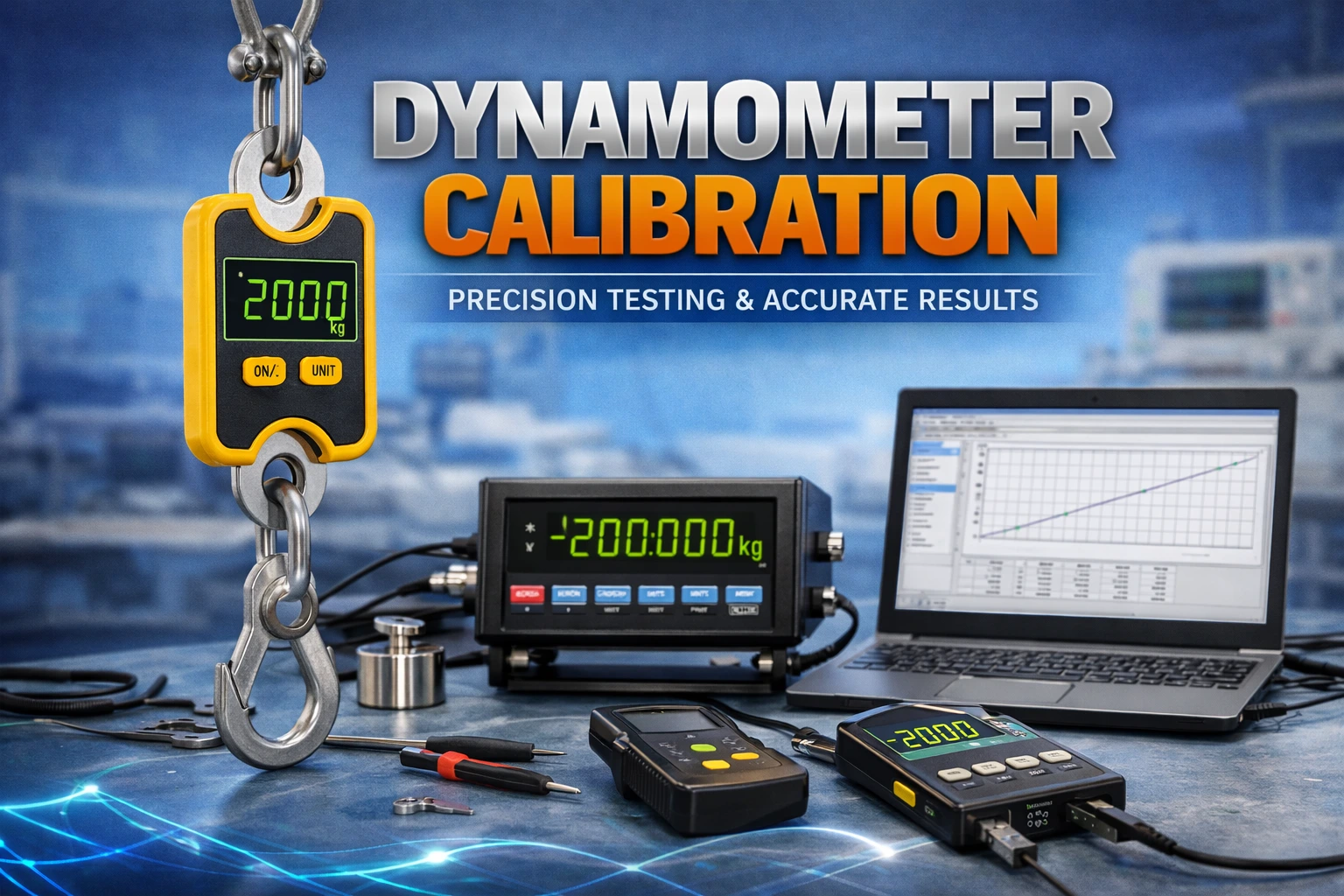
11 Apr Dynamometer Calibration: The Complete Engineer’s Guide to Accuracy, Standards, and Finding the Right Service
Every engineer who works with force measurement knows the importance of a reliable dynamometer. Whether it is used for tension testing, crane load monitoring, material pull testing, or industrial quality control, a dynamometer is only as useful as its last calibration.
Yet calibration is one of the most overlooked aspects of dynamometer maintenance in Indian industries. Instruments are purchased, put into service, and used for years without a single verified check against a traceable standard. The result? Inaccurate force data, non-compliances during audits, rework, rejected products, and, in some cases, safety incidents that could have been prevented.
In this comprehensive guide, SRUNIQ — one of India’s most advanced force calibration laboratories — breaks down everything you need to know about dynamometer calibration: the science behind it, the standards that govern it, the step-by-step process, and how to choose the right dynamometer calibration service near you.
What Is a Dynamometer?
A dynamometer is a force measurement instrument. It measures tensile or compressive forces — or both, depending on the type — and displays the magnitude in units such as Newtons (N), kilonewtons (kN), or kilogram-force (kgf).
Dynamometers are used across a wide range of industrial and engineering applications:
- Crane and hoist load testing — verifying that lifting equipment does not exceed its rated capacity
- Cable and wire tension measurement — in telecom towers, bridge cables, and suspension structures
- Material testing — tensile strength verification of metals, polymers, composites, and textiles
- Anchor bolt and fastener pull-out testing — in civil and structural engineering
- Quality control on assembly lines — checking torque and pull force in automotive components
- Ergonomics and biomechanics research — measuring human grip strength or limb force
- Geotechnical testing — pile load testing and soil anchor verification
Two broad categories exist: hand-held dynamometers (typically used for field measurements up to a few hundred kN) and industrial/bench-mounted dynamometers (capable of measuring forces from a few Newtons to several thousand kN). Both types require regular, professional calibration.
What Is Dynamometer Calibration?
Dynamometer calibration is the formal, documented process of comparing a dynamometer’s output readings against a known, traceable reference force standard to establish or confirm the instrument’s accuracy across its measurement range.
In plain language: you apply precise, known forces to the dynamometer and record what it displays. The difference between what was applied and what the dynamometer reported — at each test point — is the error. If this error falls within the manufacturer’s specified tolerance, the instrument passes calibration. If not, it needs adjustment, repair, or retirement.
The outcome of a calibration exercise is a calibration certificate. This certificate is not just paperwork — it is a legally and technically significant document that:
- Confirms the instrument was tested against a traceable reference
- Records the applied force values and corresponding dynamometer readings
- States the error (deviation) at each measurement point
- Provides the expanded measurement uncertainty
- Establishes the validity period for the next calibration
- Is accepted by ISO auditors, NABL assessors, and customers under quality frameworks
Why Dynamometer Calibration Is Not Optional
Some engineers treat calibration as a box-ticking exercise for audits. That is a costly misconception. Here are the real-world reasons why dynamometer calibration matters deeply:
Instrument Drift Is Inevitable
All force measurement instruments drift over time. The internal sensing element of a dynamometer — typically a strain gauge bonded to a machined steel body — undergoes microscopic changes with every measurement cycle. Temperature fluctuations, humidity, vibration, and gradual mechanical fatigue all contribute to a progressive shift in the instrument’s output characteristics. A dynamometer that was accurate to 0.1% when new may be reading 1.5% high after two years of regular field use — and you will not know unless you calibrate it.
Overloading Permanently Alters Accuracy
A single overloading event — applying force beyond the instrument’s rated capacity, even briefly — can permanently deform the sensing element and shift the calibration curve. Many operators do not even realize an overload occurred. Regular calibration catches this. An unchecked, post-overload dynamometer that continues in service creates liability at every measurement it makes.
Compliance Requirements Are Non-Negotiable
Multiple quality and regulatory frameworks require calibrated force measuring instruments. ISO 9001:2015 Clause 7.1.5 mandates that measuring equipment be calibrated or verified at specified intervals with traceable reference standards. IATF 16949 for automotive, AS9100 for aerospace, IS/ISO 17025 for testing laboratories — all carry the same requirement. A non-calibrated or out-of-date calibration dynamometer creates a non-conformance that can result in audit failures, customer complaints, or suspension of production.
Safety-Critical Applications Demand Verified Accuracy
In crane load testing, the dynamometer reading is the only basis for declaring whether a lift is safe. If it reads 10 tonnes when the actual load is 12 tonnes, the crane operator is working with false confidence. In structural anchor testing, an under-reading dynamometer may pass a bolt that should have failed. Calibrated dynamometers are a direct safety requirement in these applications.
Legal Metrology and Trade Compliance
Where dynamometers are used in trade or billing contexts — such as weighing raw material deliveries or measuring cable tension for billing purposes — the Legal Metrology Act of India requires that instruments be verified and certified. An uncertified instrument in a trade context carries legal risk.
Calibration Standards That Govern Dynamometer Calibration
Professional dynamometer calibration is not improvised — it follows internationally recognized technical standards that define acceptable procedures, uncertainty limits, environmental conditions, and documentation requirements.
ISO 376:2011 — Calibration of Force-Proving Instruments
This is the primary global standard for force calibration. ISO 376:2011 classifies force-proving instruments into four accuracy classes (Class 00, 0, 1, and 2) based on their repeatability, reproducibility, and zero drift. It prescribes the exact loading sequence, number of measurement series, and mathematical evaluation required for a valid calibration. SRUNIQ calibrates dynamometers in full compliance with ISO 376:2011.
ASTM E74 — Calibration of Force-Measuring Instruments
The American standard ASTM E74 governs the calibration of force measuring instruments using dead-weight machines. It is the standard of reference for customers in aerospace, defense, and advanced manufacturing who have US-based supply chain relationships or US customer requirements.
EURAMET CG-4 — Uncertainty in Force Calibration
EURAMET CG-4 is the calibration guideline from the European Association of National Metrology Institutes that provides the detailed framework for evaluating and reporting measurement uncertainty in force calibration. Proper uncertainty analysis — as defined in EURAMET CG-4 — ensures that calibration certificates are technically defensible and internationally accepted.
NABL 129 — Force Calibration in India
For operations within India, NABL (National Accreditation Board for Testing and Calibration Laboratories) accreditation under the NABL 129 technical document is the benchmark for force calibration laboratory competence. NABL-traceable calibration certificates are accepted by quality auditors, regulatory bodies, and customers across Indian industry. SRUNIQ’s calibration services align with NABL 129 requirements, ensuring that your dynamometer’s calibration certificate carries the necessary technical authority for Indian compliance.
How Dynamometer Calibration Is Performed: Step by Step
Understanding the calibration process gives you the ability to evaluate whether a calibration service is genuinely rigorous or just superficially adequate.
Step 1: Receipt Inspection and Identification
On receiving the dynamometer, the laboratory records its make, model, serial number, capacity, and resolution. A visual inspection is performed for physical damage, connector condition, display functionality, and evidence of overloading, such as permanent deformation or cracked paint on the body.
Step 2: Thermal Stabilization
The dynamometer is conditioned in the calibration environment — typically maintained at 23°C ± 2°C as specified in ISO 376:2011 — until it reaches thermal equilibrium. This step is non-negotiable. Calibrating a thermally unstable instrument introduces temperature-related errors that invalidate the results.
Step 3: Preloading
Before measurement begins, the dynamometer is preloaded — a force equal to the maximum calibration load is applied and released. This is done two or three times to condition the instrument’s mechanical behavior and ensure repeatable elastic response during the actual measurement sequence.
Step 4: Application of Reference Forces on Dead Weight Machine
The dynamometer is mounted on a dead weight force machine — the gold standard for force calibration. Dead weight machines apply force by stacking precisely calibrated masses under controlled gravitational conditions, with uncertainty contributions well below those achievable with hydraulic reference systems or secondary reference load cells.
SRUNIQ operates dead weight force machines covering 50 N to 3000 kN — one of the widest continuous force calibration ranges available at a single facility in India. This means your dynamometer, regardless of its rated capacity, can be calibrated without transferring to a different lab or compromising on accuracy.
Step 5: Multi-Point, Multi-Series Measurement
Forces are applied at multiple calibration points — typically five to ten evenly spaced points across the dynamometer’s rated range — in both ascending and descending order. This sequence is repeated a minimum of three times (as required by ISO 376:2011 for Class 1 or better classification). The measurements check for linearity, hysteresis, repeatability, and zero return.
Step 6: Uncertainty Evaluation
The calibration engineer performs a formal uncertainty analysis following the EURAMET CG-4 methodology. This quantifies all contributors to measurement uncertainty: the reference standard’s uncertainty, environmental effects, the dynamometer’s own repeatability, digital resolution, and any other identified sources. The final result is an expanded uncertainty at a 95% confidence level (coverage factor k=2).
Step 7: Calibration Certificate Issue
A comprehensive calibration certificate is generated. It contains the instrument identification, calibration date, next due date, applied force values, measured outputs at each point, percentage error at each point, expanded uncertainty, environmental conditions during calibration, the traceability chain to national standards, and the responsible calibration engineer’s details. The certificate is issued with a unique reference number for quality records management.
Types of Dynamometers SRUNIQ Calibrates
SRUNIQ calibrates the full spectrum of dynamometer types used across Indian industries:
- Tension dynamometers — used in crane load testing, cable tension, and pull testing
- Compression dynamometers — used in press force verification and structural load testing
- Universal dynamometers (tension and compression) — used in universal testing applications
- Hand-held digital dynamometers — portable field instruments used in maintenance and QC
- Hand-held analog dynamometers — spring-type instruments used in legacy applications
- Industrial crane scales with dynamometer function — overhead weighing and load monitoring
- Hydraulic dynamometers — used in heavy civil and geotechnical load testing
- Mechanical (proving ring-based) dynamometers — used in material and soil testing
Capacity range for calibration: 50 N to 3000 kN. Contact SRUNIQ to confirm calibration availability for your specific dynamometer model and rated capacity.
How Often Should Dynamometers Be Calibrated?
The required calibration interval for a dynamometer depends on your operating context:
- Annual calibration — the standard requirement for most quality management systems, including ISO 9001, IATF 16949, and AS9100
- Six-monthly calibration — recommended for dynamometers used daily in demanding environments such as outdoor construction sites, foundries, or chemical plants
- After any overloading event — mandatory recalibration whenever there is reason to believe the rated capacity was exceeded
- After repair or refurbishment, any mechanical intervention on the sensing element or display system requires recalibration before return to service
- Before critical measurements — for safety-critical tests such as proof load testing of cranes or anchors, calibration immediately prior to the test is best practice
A common industry mistake is setting fixed calendar-based intervals and forgetting that abnormal events — a drop, an overload, a repair — override the schedule. SRUNIQ provides application-specific calibration interval recommendations when issuing certificates.
How to Find the Right Dynamometer Calibration Service Near You
When you search for dynamometer calibration services near you, the results may include general instrument calibration shops, electrical calibration labs, and dedicated force calibration laboratories. Not all are equal. Here is how to identify a service provider that will give you technically valid, auditor-accepted results:
Verify Traceability to NABL or NPL
The calibration certificate is only as strong as its traceability chain. In India, all accredited calibrations must trace back to NABL (National Physical Laboratory, India) or an equivalent national metrology institute. Ask for the lab’s NABL certificate number or ask specifically which NABL-accredited laboratory their reference standards are calibrated against.
Confirm Use of a Dead Weight Force Machine
This is the single most important technical question. Dead weight machines provide the highest achievable accuracy in force calibration. Labs that rely only on hydraulic force standards or reference load cells have higher uncertainty, which may not meet your quality requirements or the ISO 376:2011 classification you need. SRUNIQ uses dead weight force machines exclusively for primary force calibration.
Check the Force Range Coverage
A lab that covers only up to 50 kN or 100 kN cannot calibrate a 500 kN dynamometer accurately. Confirm that the lab’s certified range covers your dynamometer’s full rated capacity. SRUNIQ’s facility covers 50 N to 3000 kN continuously — handling virtually all industrial dynamometers without capability gaps.
Ask About Uncertainty Values
A credible calibration lab should be able to tell you its expanded measurement uncertainty before you commit. If a lab cannot state its uncertainty, or quotes only a vague percentage without a formal evaluation, treat that as a red flag. Uncertainty values should be stated as part of the accreditation scope.
Review the Calibration Certificate Format
Ask for a sample calibration certificate. It should contain: instrument details, calibration method reference (ISO 376 / ASTM E74), applied force values, measured outputs, percentage errors, expanded uncertainty, environmental conditions, traceability statement, and engineer sign-off. A certificate that contains only a pass/fail statement without measurement data is technically inadequate for most quality management systems.
Consider Turnaround Time and Logistics
For instruments critical to operations, downtime matters. SRUNIQ offers a 24 to 48-hour standard turnaround for dynamometer calibration. We also offer on-site calibration for large or integrated dynamometer systems that cannot be easily transported. Our facility in GB Nagar, Uttar Pradesh, is conveniently located to serve customers across Delhi NCR, Noida, Greater Noida, Ghaziabad, Faridabad, Gurugram, and across North India.
Why Engineers and Quality Managers Across India Choose SRUNIQ
SRUNIQ Measurement Technologies & Consultancy has positioned itself as the precision force calibration partner of choice for industries that cannot afford inaccuracy. Here is what sets us apart:
- Dead weight force machines covering 50 N to 3000 kN — India’s widest single-facility force calibration range
- Full compliance with ISO 376:2011, ASTM E74, EURAMET CG-4, and NABL 129
- Climate-controlled calibration laboratory ensuring temperature-stable, reproducible results
- Comprehensive uncertainty analysis with every certificate — not just a pass/fail
- Calibration of all dynamometer types: tension, compression, universal, hand-held digital and analog, hydraulic, and crane scales
- Standard turnaround of 24 to 48 hours — minimizing instrument downtime
- On-site calibration capability for large or permanently installed dynamometer systems
- Over 10,000 instruments calibrated annually across aerospace, automotive, manufacturing, construction, energy, defense, research, and medical sectors
- Experienced team of calibration engineers and metrologists with sector-specific knowledge
Our customers include quality teams preparing for ISO audits, engineers validating crane and lifting equipment, R&D labs requiring reference-grade force data, and production facilities needing continuous measurement confidence.
Frequently Asked Questions
My dynamometer still reads zero correctly — does it still need calibration?
Yes. A correct zero reading only confirms the instrument’s offset at zero load. It tells you nothing about linearity across the measurement range, repeatability under load, or deviation at the points where you actually make measurements. Only a full multi-point calibration can confirm overall accuracy.
Can you calibrate a dynamometer that has been dropped or overloaded?
Yes — and in fact, this is exactly when calibration is most important. A post-incident calibration determines whether the instrument is still within tolerance or has been permanently damaged. SRUNIQ will calibrate the instrument and provide a certificate reflecting its post-incident condition. If it is out of tolerance, we will clearly document this so you can make an informed decision about continued use or replacement.
Do you provide on-site dynamometer calibration?
Yes. For permanently mounted dynamometers in load testing rigs, overhead crane systems, or integrated production equipment where removal is impractical or risky, SRUNIQ offers on-site calibration services. Contact us to discuss the logistical requirements for your specific installation.
What is the difference between a Class 0 and Class 1 dynamometer calibration?
Under ISO 376:2011, the classification refers to the accuracy class of the instrument being calibrated. Class 0 instruments have stricter tolerances (typically used as reference standards themselves), while Class 1 and Class 2 instruments are used in industrial measurement and testing applications. Your quality system or customer may specify which class of calibration is acceptable. SRUNIQ can advise on the appropriate class for your application.
How do I get my dynamometer calibrated at SRUNIQ?
Contact us at info@sruniq.com or call 8750841107. We will confirm range compatibility, provide a quote, and arrange collection or direct submission to our facility at Khasra No. 179, Vashrabad Village, Dadri, GB Nagar, UP — 203207. Standard turnaround is 24 to 48 hours from instrument receipt.
Conclusion: Calibrated Dynamometers Are the Foundation of Reliable Force Measurement
A dynamometer is a precision instrument — but precision degrades over time without verification. Every force measurement your organization makes is only as trustworthy as the last calibration certificate of the instrument that made it.
Whether you are running ISO audits, qualifying lifting equipment, testing material strength, or monitoring structural loads — a calibrated dynamometer is not a luxury. It is the baseline of engineering confidence.
At SRUNIQ, we have built one of India’s most capable force calibration facilities specifically to serve the engineers and quality teams who understand this. With the widest force calibration range in the country, full standards compliance, and a fast turnaround, we are ready to be your calibration partner.
Do not wait for an audit finding or a measurement anomaly to prompt action. Schedule your dynamometer calibration with SRUNIQ today and keep your measurements where they belong — accurate, traceable, and defensible.
No Comments