
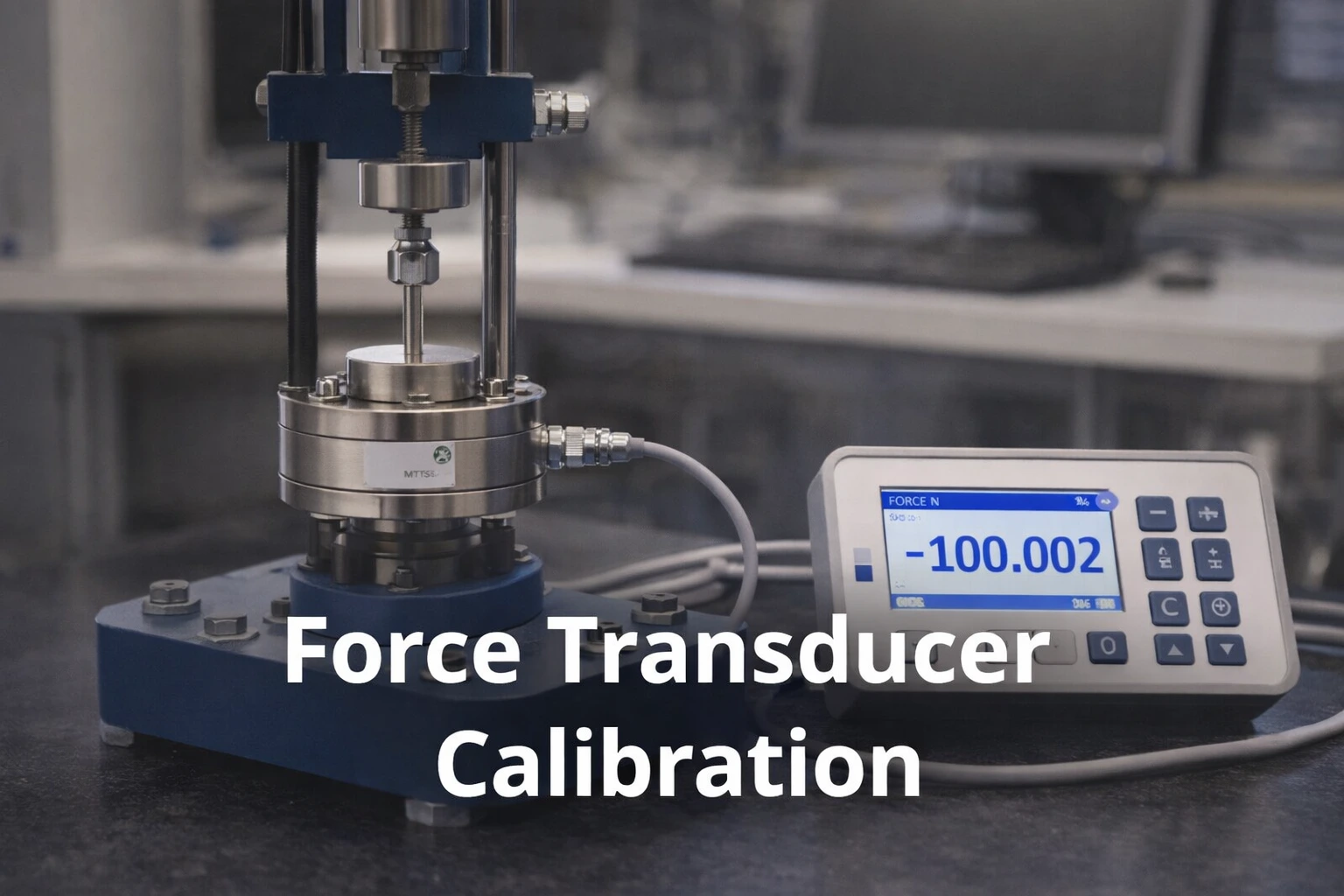
In the world of precision engineering and industrial measurement, force transducers are among the most critical instruments in service. They convert mechanical force into an electrical signal — and that signal drives decisions. Decisions about product quality, structural safety, manufacturing tolerances, research validity, and regulatory compliance.
But here is the reality that many engineers and quality managers overlook: a force transducer that has not been recently calibrated is an instrument of assumption, not measurement. Its readings represent what you hope the force is, not what it actually is.
At SRUNIQ Measurement Technologies & Consultancy, we specialize in force calibration across one of the widest ranges available in India — 50 N to 3000 kN — using dead weight force machines and internationally certified procedures. In this blog, we walk you through everything you need to know about force transducer calibration: what it is, why it matters, how it works, which standards govern it, and how to find the right calibration service near you.
What Is a Force Transducer?
A force transducer is an electromechanical sensing device that converts an applied mechanical force — whether tensile, compressive, or shear — into a proportional electrical output signal. This signal is typically a voltage, current, or digital value that an indicator, data logger, or control system can read and record.
The most common type of force transducer is the strain-gauge-based transducer. In this design, precision strain gauges are bonded to a machined metallic elastic element. When force is applied, the element deforms microscopically, the strain gauges change their electrical resistance, and a Wheatstone bridge circuit converts this resistance change into a measurable voltage output.
Force transducers are used across virtually every high-accuracy force measurement application in industry and research:
- Structural health monitoring — measuring loads in bridges, towers, and foundation piles
- Aerospace component testing — measuring aerodynamic forces, thrust, and structural loads in test rigs
- Automotive crash and fatigue testing — quantifying impact forces and endurance loads
- Material testing machines — acting as the primary sensing element in universal testing machines (UTMs)
- Robotics and automation — providing force feedback in assembly robots and collaborative machines
- Medical devices and prosthetics — measuring interaction forces in biomechanical research
- Precision weighing systems — as the sensing element in high-resolution laboratory balances and industrial scales
- Defense and ballistics testing — measuring projectile forces and blast pressures
- Energy and power generation — monitoring forces in turbine components and wind energy structures
The common thread across all these applications is that the accuracy of the force transducer directly determines the quality and reliability of every decision made from its output. This is why calibration is not a formality — it is a technical necessity.
What Is Force Transducer Calibration?
Force transducer calibration is the formal, traceable process of determining the relationship between the force applied to a transducer and the electrical output it produces — and comparing that relationship against a known reference standard to quantify accuracy.
In practical terms, calibration answers four fundamental questions about your force transducer:
- Is the transducer’s output at each measurement point consistent with its rated sensitivity specification?
- What is the actual error (deviation) between the applied force and the indicated value?
- How repeatable are the readings across multiple loading sequences?
- What is the measurement uncertainty of the transducer in its calibrated condition?
Calibration does not automatically mean the instrument is adjusted. It means the instrument’s performance is rigorously measured, documented, and verified against a traceable reference. If the transducer is within its specification, it is certified as such. If it is out of tolerance, the calibration certificate documents the deviation, and a decision is made about repair, adjustment, or replacement.
The output of calibration is a calibration certificate — a document with legal, technical, and quality management significance that every serious quality system requires for its measuring instruments.
Why Force Transducer Calibration Is a Technical Requirement, Not a Choice
Some organizations calibrate their force transducers because an auditor requires it. The best organizations calibrate because they understand what happens when they do not. Here are the concrete technical reasons why calibration is essential:
1. Sensitivity Drift Over Time
The strain gauges inside a force transducer are bonded to a metallic substrate with adhesive. Over time, the adhesive can creep, the gauge filaments can fatigue, and the elastic element itself can undergo stress relaxation. All of these effects cause the transducer’s sensitivity — its output per unit of applied force — to shift from its factory specification. A transducer reading 1.000 mV/V at commissioning may be reading 0.985 mV/V two years later. That 1.5% drift means every force value recorded during that period is incorrect by the same margin.
2. Zero Offset Accumulation
Repeated loading cycles, thermal expansion and contraction, and mechanical shock can cause the transducer’s zero output — its reading under no load — to shift. A transducer with a significant zero offset introduces a systematic bias into every measurement it makes. Calibration detects and quantifies this offset.
3. Connector and Cable Degradation
Force transducers in field applications are connected through cables and connectors subject to flexing, vibration, moisture ingress, and corrosion. Connector resistance changes can alter the excitation voltage reaching the bridge circuit, directly affecting the output. Calibration performed as a complete system — transducer plus cable plus indicator — captures these effects that component-level inspection misses.
4. ISO and Quality Management Compliance
ISO 9001:2015, Clause 7.1.5 explicitly requires that measuring equipment used to verify product and process conformance be calibrated at specified intervals against measurement standards traceable to international or national standards. Force transducers used in quality control, acceptance testing, or process verification fall squarely under this requirement. An uncalibrated or overdue transducer is a documented non-conformance in any ISO audit.
5. Customer and Regulatory Requirements
Aerospace customers under AS9100, automotive customers under IATF 16949, and defense customers under AQAP-2110 all mandate calibrated measuring instruments with documented traceability. A force transducer without a valid calibration certificate from a recognized laboratory will not be accepted in PPAP documentation, first article inspection reports, or test data packages submitted to these customers.
6. Safety-Critical Measurement Integrity
In applications where force transducer output drives a safety decision — such as proof load monitoring, structural health monitoring, or aerospace test stand operation — an uncalibrated transducer is a direct safety risk. The consequences of acting on inaccurate force data in these contexts extend well beyond commercial liability.
International Standards Governing Force Transducer Calibration
Professional force transducer calibration is governed by a suite of internationally recognized standards. Understanding these standards helps you specify the right calibration for your application and interpret the certificates you receive.
ISO 376:2011 — Calibration of Force-Proving Instruments
ISO 376:2011 is the primary international standard for force calibration. It defines four accuracy classification levels — Class 00, Class 0, Class 1, and Class 2 — based on the instrument’s repeatability, reproducibility, resolution, and interpolation error. The standard prescribes the exact loading sequences, the number of measurement series, and the mathematical treatment required to assign an accuracy class. For force transducers used as reference standards or in precision testing applications, Class 0 or Class 00 calibration under ISO 376 is typically specified.
ASTM E74 — Standard Practice for Calibration of Force-Measuring Instruments
ASTM E74 is the American standard that governs force calibration using dead weight machines. It establishes the lower limit factor (LLF) concept — a statistically derived lower bound on the usable force range of the instrument based on its calibration performance. ASTM E74 certification is routinely required by US-based customers in aerospace, defense, and precision manufacturing supply chains.
EURAMET CG-4 — Guidelines on the Determination of Uncertainty in Force Measurements
Issued by the European Association of National Metrology Institutes, EURAMET CG-4 provides the definitive technical framework for evaluating and reporting measurement uncertainty in force calibration. It identifies all significant uncertainty contributors — reference standard uncertainty, environmental effects, instrument repeatability, resolution, and hysteresis — and specifies how to combine them into a single expanded uncertainty value at 95% confidence. Calibration certificates without a proper uncertainty analysis as described in EURAMET CG-4 are technically incomplete.
NABL 129 — Technical Requirements for Force Calibration Laboratories in India
For Indian industry, NABL (National Accreditation Board for Testing and Calibration Laboratories) accreditation under NABL 129 is the benchmark for force calibration laboratory competence. A calibration certificate issued by a NABL-accredited laboratory is accepted by quality auditors, government regulatory bodies, and customers across all major industry sectors in India. SRUNIQ operates in alignment with NABL 129 requirements, ensuring full traceability of all force transducer calibration results to the National Physical Laboratory of India.
The Force Transducer Calibration Process: Step by Step
A rigorous force transducer calibration follows a defined sequence. Here is exactly how SRUNIQ approaches each calibration:
Step 1: Instrument Identification and Pre-Calibration Inspection
Every force transducer received is uniquely identified — make, model, serial number, rated capacity, sensitivity specification, and excitation voltage. A physical inspection is performed: the elastic element is examined for deformation or cracking, connectors are checked for corrosion and pin integrity, and the cable is inspected for damage. Anomalies are photographed and documented before calibration begins.
Step 2: System Setup and Environmental Stabilization
The transducer is connected to its calibrated signal conditioner or indicator. The complete system is placed in our climate-controlled calibration environment and allowed to stabilize at 23°C ± 2°C as required by ISO 376:2011. Rushing thermal stabilization is the most common shortcut taken by under-equipped labs — and it introduces systematic thermal errors that invalidate the calibration.
Step 3: Electrical Zero and Excitation Verification
Before loading, the transducer’s zero output is recorded and the excitation voltage is verified at its rated value. This establishes the electrical baseline and catches any pre-existing zero offset that may have accumulated since the last calibration.
Step 4: Preloading to Condition the Instrument
The transducer is preloaded to its maximum calibration force two or three times and returned to zero. This conditions the elastic element and the strain gauge adhesive, eliminating transient effects that would otherwise affect the first measurement series. ISO 376:2011 mandates this preloading sequence for valid classification results.
Step 5: Multi-Point Measurement on Dead Weight Force Machine
The transducer is loaded on SRUNIQ’s dead weight force machine — the most accurate type of primary force standard available. Dead weight machines generate force by precisely stacking calibrated masses under controlled local gravitational acceleration, achieving reference uncertainties that are not achievable with hydraulic force standards or secondary reference transducers.
Forces are applied at multiple calibration points across the transducer’s rated range — typically five to ten evenly spaced points — in both increasing and decreasing sequences (to characterize hysteresis). The complete measurement sequence is repeated a minimum of three times to evaluate repeatability. For transducers requiring ISO 376 Class 0 classification, additional measurement series are performed.
Step 6: Sensitivity, Linearity, Hysteresis, and Repeatability Analysis
From the measurement data, the calibration engineer calculates the key performance parameters: sensitivity (output per unit force), non-linearity, hysteresis, and repeatability. These are compared against the manufacturer’s specifications and the ISO 376 classification limits applicable to the transducer’s intended use.
Step 7: Measurement Uncertainty Evaluation
Following EURAMET CG-4 methodology, a formal uncertainty budget is constructed. Every identified uncertainty contributor is quantified — the dead weight machine’s reference uncertainty, environmental temperature stability, the transducer’s own repeatability, digital resolution of the readout, and any hysteresis contribution. These are combined in quadrature to produce the expanded uncertainty at 95% confidence level.
Step 8: Calibration Certificate Issue
A comprehensive calibration certificate is generated, containing: unique certificate number, instrument identification, calibration date and next due date, applied force values at each calibration point, measured output values, deviation (error) at each point, expanded measurement uncertainty, environmental conditions during calibration, applicable standards, traceability statement to national standards, and the calibration engineer’s identity and sign-off. This certificate is the document your quality system, auditor, and customer require.
Types of Force Transducers SRUNIQ Calibrates
SRUNIQ calibrates all major force transducer types and configurations across a range of 50 N to 3000 kN:
- Compression force transducers — used in press monitoring, structural testing, and platform weighing
- Tension force transducers — used in material pull testing, cable tension monitoring, and crane load cells
- Universal (tension and compression) force transducers — the primary sensing element in most universal testing machines
- S-beam force transducers — compact, versatile sensors used in automation, robotics, and test rigs
- Button / miniature load button transducers — used in confined-space force measurement in tooling and assembly
- Pancake / low-profile force transducers — used in bolt load monitoring, press fitting, and structural applications
- In-line force transducers — installed directly in force transmission chains in production machinery
- High-temperature force transducers — calibrated with reference conditions and extrapolation notes for elevated temperature applications
- Custom and OEM force transducers — non-standard configurations calibrated against traceable reference forces
How Often Should Force Transducers Be Calibrated?
Calibration interval decisions should be based on technical risk, not administrative convenience. These factors should guide your interval:
- Frequency of use — transducers in continuous production use require shorter intervals than those used occasionally
- Environmental severity — outdoor, high-temperature, high-humidity, or high-vibration environments accelerate drift
- Quality system requirements — ISO 9001, IATF 16949, AS9100, and NABL accreditation all mandate defined calibration intervals, typically annual as a minimum
- Measurement criticality — force transducers used in safety-critical or acceptance testing roles should be calibrated more frequently than those used for indicative monitoring
- Post-overload or post-incident recalibration — any event that may have subjected the transducer to forces exceeding its rated capacity requires immediate recalibration before return to service
- After repair or connector replacement — any physical intervention in the transducer system requires recalibration of the complete system
At SRUNIQ, we provide application-specific calibration interval recommendations as part of our service. We do not issue a generic 12-month validity to every certificate — we consider your application context and advise accordingly.
Finding the Right Force Transducer Calibration Service Near You
Searching for force transducer calibration services near you will surface a wide range of providers — from general instrument calibration shops to dedicated metrology laboratories. The quality difference between these providers is significant. Here is how to evaluate them:
Traceability to NABL or National Metrology Institute
Every calibration certificate must carry a traceable link to a national measurement standard. In India, this means traceability to NABL or directly to NPL (National Physical Laboratory, India). Ask for the laboratory’s NABL scope of accreditation and confirm that force calibration is explicitly listed in the scope document.
Dead Weight Force Machine Capability
This is the most important technical question to ask any force calibration laboratory. A dead weight machine achieves reference uncertainties typically 5 to 10 times better than hydraulic or secondary reference systems. If a laboratory cannot confirm use of a dead weight machine, their calibration uncertainty may not meet the requirements of ISO 376 Class 1 or better — which most precision applications demand. SRUNIQ’s primary calibration capability is built entirely on dead weight force machines.
Force Range Coverage
Confirm that the laboratory’s calibrated force range covers your transducer’s full rated capacity. Many labs are limited to 100 kN or 200 kN. If your transducer is rated at 500 kN, 1 MN, or 2 MN, you need a facility that can apply those forces accurately. SRUNIQ covers 50 N to 3000 kN — one of the widest continuous ranges at any single facility in India — handling transducers for industries from precision electronics to heavy civil construction.
Uncertainty Statement in Calibration Scope
A credible laboratory should be able to state its expanded measurement uncertainty for force calibration before you send your instrument. This uncertainty should be significantly smaller than your transducer’s accuracy specification. If the lab’s uncertainty is comparable to or larger than the transducer’s tolerance, the calibration result is technically meaningless. Request the uncertainty statement explicitly.
Qualified Calibration Engineers
Force transducer calibration is a specialist discipline. The engineers performing the calibration should have formal metrology training and practical experience with force measurement. At SRUNIQ, every calibration is performed by qualified calibration engineers who understand the behavior of different transducer technologies and can provide application-specific technical guidance.
Turnaround Time and On-Site Capability
For force transducers integrated into production equipment, test rigs, or permanent installations, on-site calibration is often the only practical option. SRUNIQ offers both laboratory calibration with 24 to 48 hours standard turnaround and on-site calibration for transducers that cannot be removed from service. Our facility in GB Nagar, Uttar Pradesh, serves customers across Delhi NCR, Noida, Greater Noida, Ghaziabad, and North India, with on-site teams available for broader coverage.
Why SRUNIQ Is the Force Transducer Calibration Partner You Need
SRUNIQ Measurement Technologies & Consultancy was established with a single purpose: to give Indian industry access to force calibration at the highest level of accuracy and technical rigor. Our differentiators are not marketing claims — they are technical specifications:
- Dead weight force machines covering 50 N to 3000 kN — primary-level accuracy for the widest force range at a single Indian facility
- Full compliance with ISO 376:2011, ASTM E74, EURAMET CG-4, and NABL 129 — internationally defensible calibration certificates
- Climate-controlled laboratory at 23°C ± 2°C — temperature-stable conditions ensuring reproducible, standard-compliant results
- Comprehensive uncertainty analysis with every certificate — not a pass/fail stamp but a complete technical document
- Calibration of all force transducer types: compression, tension, universal, S-beam, button, pancake, and in-line configurations
- 24 to 48 hours standard turnaround — minimizing instrument downtime in your quality system
- On-site calibration capability for permanently installed or large-scale transducer systems
- Over 10,000 force measurement instruments calibrated annually across aerospace, automotive, manufacturing, construction, energy, defense, research, and medical sectors
- Application-specific calibration interval advisory — we help you set technically justified re-calibration schedules
Frequently Asked Questions About Force Transducer Calibration
What is the difference between a force transducer and a load cell?
In technical usage, a force transducer is a broader category that includes any device converting force to an electrical signal, while a load cell is a specific type of force transducer typically used in weighing and mass determination. All load cells are force transducers, but not all force transducers are load cells. The calibration methodology for both is similar — ISO 376 and NABL 129 apply equally to both instrument types.
Can a force transducer be calibrated at a different capacity than its rated capacity?
Yes — and this is common in practice. If your application only uses the lower 50% of a transducer’s rated range, SRUNIQ can calibrate it over that working range with reduced uncertainty, often achieving a better accuracy class. We can also calibrate above the nominal rated capacity if the transducer is designed for over-range use, subject to confirmation with the manufacturer’s specifications.
My force transducer is integrated into a test machine — can SRUNIQ calibrate it in place?
Yes. SRUNIQ offers on-site calibration for force transducers that are permanently installed or integrated into test rigs, press machines, UTMs, or structural monitoring systems. Our portable calibration equipment maintains the accuracy and traceability of our laboratory-based service. Contact us to discuss your specific installation and we will confirm the technical feasibility and logistics.
What should a valid calibration certificate for a force transducer contain?
A technically complete calibration certificate must include: unique certificate identification, full instrument description, calibration date and validity period, reference to the calibration standard used (ISO 376:2011 or ASTM E74), applied force values at each calibration point, transducer output at each point, percentage error or deviation, expanded measurement uncertainty with coverage factor, environmental conditions during calibration, traceability statement to national standards, and the responsible calibration engineer’s signature. If any of these elements are missing, the certificate may not be accepted by quality auditors.
How do I submit my force transducer to SRUNIQ for calibration?
Contact SRUNIQ at info@sruniq.com or call 8750841107. Share your transducer’s make, model, rated capacity, sensitivity, and excitation voltage, and we will confirm our calibration capability and provide a quote. Our facility is located at Khasra No. 179, Vashrabad Village, Dadri, GB Nagar, UP — 203207. Standard laboratory turnaround is 24 to 48 hours from receipt of the instrument.
Accurate Force Transducers Begin With Rigorous Calibration
Force transducers are the foundation of reliable force measurement. But a transducer’s accuracy is not a permanent property — it must be verified, documented, and maintained through a disciplined calibration programme.
Whether your transducers are used in aerospace test rigs, automotive production lines, material testing machines, structural monitoring systems, or research laboratories, their calibration certificates are the evidence that your measurements are technically defensible. Without that evidence, every force value your instruments have produced is a number of uncertain reliability.
SRUNIQ exists to give you that certainty. With India’s widest force calibration range, dead weight machine accuracy, full standards compliance, and a team that understands the engineering context of your measurements, we are the calibration partner that engineers trust when accuracy is the baseline requirement.
Schedule your force transducer calibration with SRUNIQ today. Accurate measurements start here.
Leave a Reply